

What to Bring Someone in the Hospital: A Survivor's Guide
Written by a three-time cancer survivor, this is the real list of what helps during a hospital stay — and why every item in our kits was built from actually living it, not guessed at.

Someone you love is in the hospital, and you're standing there with the same question everyone has: what do I actually bring? What do they need?
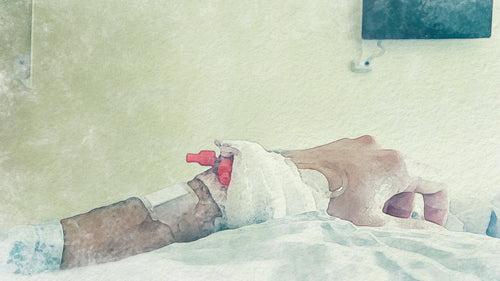
I've sat on the other side of that question more times than I'd like. Three separate cancer diagnoses meant three separate stretches in hospital beds — some short, some long enough that the room stopped feeling like a hospital and started feeling like a strange apartment I hadn't agreed to live in. I had a lot of visitors during those stays. Most brought flowers, which wilted by the second day, or magazines I never opened. A few brought exactly the right things. I remember every one of those people years later — not because the gift was expensive, but because someone had actually thought about what the day-to-day was like.
That's the difference this guide is trying to make. Not nice gestures — the specific things that get used, every day, by someone living in a hospital bed.
The Comfort Problem
The blanket they give you is thin, scratchy, and somehow always too short. That's annoying, but it's not the real problem. The real problem is you can't keep it on when you're moving around. Nurses want you walking as soon as you can — it's one of the few things that genuinely speeds recovery — and the second you stand up with an IV pole in one hand, whatever's covering you slides off and gets left on the bed. You end up cold, or carrying a blanket bundled awkwardly under one arm.
I noticed this on my first walk down the hall during my second diagnosis — gown open at the back, blanket dragging, trying to hold my water bottle, an IV pole, and dignity all at once. A small humiliation, but it adds up over days.
If you're choosing a blanket for someone, look for one built to be worn, not just draped — something that wraps and stays closed while you're up and moving, ideally with somewhere to put a phone, since hospital gowns have zero pockets. That's the entire reason the CozyWrap Blanket exists. It was the single most-used item anyone ever gave me, and it anchors The Comfort & Care Kit, our complete hospital kit.
The Mobility Problem
Those hallway walks taught me the second lesson: hospital floors are always cold, and a thirty-second walk takes five minutes when you're recovering from something major. Grip socks slide more than they grip, with no real warmth. Slippers, even nice ones, are often heavier than they look and fall off constantly in bed — heavy, clumsy footwear is the last thing you need.
What matters is that they're light enough to forget you're wearing them, and that they stay on — because you're in and out of bed constantly, for trips to the bathroom, tests and hallway walks. That's what the 24-Hour Slippers are built around. The name isn't a flourish; it's the actual use case.
The Rest Problem
Nobody warns you how loud and active a hospital is at 3 a.m. Monitors beep, carts roll past, a roommate's TV stays on. And rest is exactly what your body is using to heal, which makes the lack of it feel almost cruel.
A sleep mask and earplugs sound too simple to matter, but they gave me some of the only real sleep I got during longer stays. The details matter, though. Cheap synthetic masks get clammy fast; silk stays cool and holds up. A single pair of earplugs disappears — rolls under the bed, wears thin — usually before the stay is over.
That's why our Silk Sleep Mask is 100% Mulberry silk, and the Soft Ear Plugs come eight pairs deep in a reusable case instead of one. The average stay runs about 7.3 days. We'd rather you have more than you need than run out on day four. Both are in The Comfort & Care Kit; The Sleep Kit covers just this, on its own.
The Hydration Problem
This is the one nobody thinks to ask about until they're living it: a flimsy styrofoam cup assumes you can sit up to drink from it. Right after surgery, that assumption falls apart — and so does taking medication on schedule, since most come as pills that need water — pretty difficult while lying flat with a styrofoam cup.
The Easy-Sip Hydration Bottle exists because of that exact gap — built to actually work lying flat, not just marketed as spill-proof and then failing the moment you tip your head back. One woman recovering from a liver transplant told us this was the detail she didn't expect to matter as much as it did. You only learn that by living it, not by guessing.
The "What Did the Doctor Just Say" Problem
Hospitals are a place of information overload, and you're rarely in a state to absorb it. A doctor appears for ninety seconds during 7 a.m. rounds, says six important things, and disappears. Then a family member calls asking what was said, and you're reconstructing it from memory under stress — which goes about as well as you'd expect.
A simple notebook solved this for me more than almost anything else: questions written down before rounds, notes on what was actually said right after, while it's still fresh. That's the entire reason we include a Notebook with Pen in The Comfort & Care Kit. More than one person has told us they still pull theirs out at follow-up appointments, months after discharge. It keeps all their medical details in one place.
The "Where Do My Things Go" Problem
Hospital rooms have almost no real storage — a narrow closet, maybe a drawer. Personal items end up scattered across a windowsill, or stuffed back into whatever bag they arrived in — or, in my case, a white garbage bag the hospital staff was kind enough to give me.
A proper Duffel Bag gives you one place to keep things, and one bag to grab on the way home. The Laundry Bag solves the part nobody thinks of until it's a problem — keeping worn clothes separate, so a loved one can take it home to wash without digging through everything else. Small details. The kind you only think to include if you've lived through needing them.
What We Leave Out, On Purpose
No clothing, toiletries, or charger in our kits — deliberately. Sizes, scents, and charger types are different for every person, which makes them easy to get wrong as a gift. Everything we do include works for any patient, in any hospital. That's the design principle.
If you're bringing those yourself: keep clothing loose and easy on and off, since IV lines make anything fitted harder than it should be. Keep toiletries unscented — rooms are often shared. And bring a longer charging cable than you think you need; outlets are never where you'd expect.
A Few Quick Questions
Should I ask before bringing gifts? A quick text to family first — some units, like ICU or transplant, have restrictions.
What about food? Worth checking first. Many patients have dietary restrictions, so non-perishable is the safer bet.
Can a kit be shipped straight to the hospital? Yes — include the patient's name and room number, and check the hospital's mail room policy.
Built By Someone Who's Actually Been There
Every item above — the CozyWrap Blanket, the 24-Hour Slippers, the Silk Sleep Mask and Soft Ear Plugs, the Easy-Sip Hydration Bottle, the Notebook with Pen, the Duffel Bag, the Laundry Bag — came out of an actual hospital bed, not a product meeting. It's what I wished someone had handed me, refined after three stays until it actually worked.
The Comfort & Care Kit is all of it together. If sleep is the one thing someone's struggling with most, The Sleep Kit covers the blanket, mask, and earplugs on their own, at a lighter price.
You can't take away what someone you love is going through. But you can hand them something built by a person who's actually sat in that bed, instead of guessed at what it might be like.
Geoff is a three-time cancer survivor and co-founder of Getwell Goods. Every item in our kits was designed from his own hospital stays — built to solve the problems he actually lived through, not the ones a product team guessed at.

Ready to send real comfort?
Thoughtfully designed hospital care kits, made by a patient, for patients. Ships within 24 hours.
Shop The Comfort & Care Kit